Nishiwaga Town in Iwate Prefecture is surrounded by deep, untouched nature and is known as a region of heavy snowfall.
The warabi (bracken fern) harvested in Nishiwaga is exceptional — thick, silky, and truly splendid!
During its season, it plays a starring role in BELLINO Hotel’s Japanese cuisine.
This time, we’ll introduce you to where it’s grown.
Nishiwaga’s Warabi Is a Gift from the Mountains! The Fields of Nishiwaga Industrial Corporation
Nishiwaga Town is about a 1-hour drive northeast from Ichinoseki.
We drove there surrounded by fresh greenery.
We were guided by Mr. Kazuhiro Aizawa, department manager of Nishiwaga Industrial Corporation.
Nishiwaga Industrial Corporation offers the natural appeal of Nishiwaga through local specialty products, hot springs, and the operation of a roadside station.

We arrived at a field surrounded by nature!
Looking around…

Thick, long, splendid warabi!
This is a field of “black warabi.”
The part in the center of the photo, where the fronds haven’t yet unfurled, is at its peak for eating.

Our staff got to try harvesting warabi.
You pick it a little above the base, at the point where it snaps cleanly.
It has just the right amount of give. Once you’ve gathered a bundle, you can really feel the weight.

Apparently, this particular area is intentionally left unharvested for the next season.
Why does Nishiwaga’s warabi grow so splendidly?
Apparently it’s thanks to Nishiwaga’s climate and soil.
Nishiwaga is located roughly in the center of the Ou Mountains and is surrounded by mountains.
The warabi that grows from rhizomes which have absorbed abundant snowmelt after winter is said to be moist and silky.
Truly a gift from nature.
Nishiwaga Isn’t Just Warabi! Plenty of Wild Mountain Vegetables
In Nishiwaga’s rich natural environment, many kinds of wild mountain vegetables (sansai) grow.
There were various sansai in the fields of Nishiwaga Industrial Corporation as well.

Manager Aizawa and Japanese Cuisine Head Chef Ueno harvested Oo-naruko-yuri (giant Solomon’s seal) and gyoja-ninniku (victory onion) shoots.

↑ You eat the young shoots of oo-naruko-yuri.
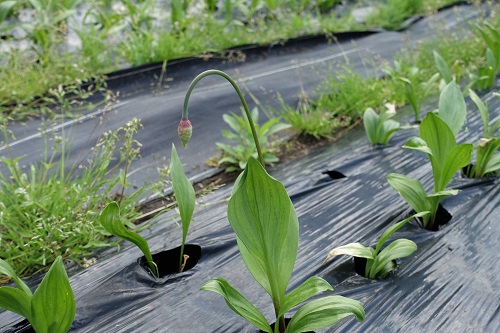
↑ Gyoja-ninniku shoots.

We were able to harvest quite a lot!
From right to left: black warabi, oo-naruko-yuri, and gyoja-ninniku shoots.
Afterward, we moved to Hotto-Yuda Station, where we enjoyed sansai cuisine at a restaurant inside Yumu Plaza in front of the station.

↑ Sansai tempura soba. The soba noodles use warabi (bracken) starch.

↑ Ohitashi (blanched and seasoned) black warabi. It’s moist and silky.
For the people of Nishiwaga, sansai seem to be a familiar part of everyday life, and they enjoy them in many ways — as ohitashi, tempura, and even in miso soup.
Enjoy Nishiwaga’s Warabi and Sansai at BELLINO HOTEL ICHINOSEKI!
Japanese Restaurant Nanohana at BELLINO HOTEL ICHINOSEKI uses sansai from Nishiwaga.

We also make generous use of other ingredients from Iwate Prefecture.
Please be sure to enjoy them!
《 Reference 》
★Nishiwaga Industrial Corporation Website